- This section breaks down six real causes of "they all taste the same"
- This section gives a minimum recording protocol: four fields, a 0–5 intensity scale, and downweighting rules
- This section splits one cigarette into seven slots, from cold scent to aftertaste
How to Objectively Record and Describe the Flavor of a Cigarette — Building Your Own Tasting Language
At 8:15 PM on October 7, 2023, I sat at the desk of a rented room of about 12 m² in Chaoyang, Beijing, ready to run a "vocabulary checkup." Only three things sat on the desk: a blended cigarette labeled with around 10 mg of tar, a glass of plain water that had been sitting for half an hour, and three historical notes in my phone's memo app. The three notes were written in 2021, 2022, and the spring of 2023 respectively, and their content was remarkably consistent:
- "Tastes okay, a bit of a smoke taste."
- "Harsher than last time, throat a little dry."
- "The middle seems a bit sweeter, hard to say."
The thermo-hygrometer read 23.6℃ with 41% relative humidity. The heating season had not officially begun, and the air was already on the dry side. I lined up the three notes and zoomed in, suddenly realizing an uncomfortable truth: **I had smoked for years, yet my recording ability had barely moved past "the chat level of someone who smokes."** My nose was not broken; what was missing was a usable coordinate system in my head — no intensity scale, no references, no timeline. Every sensation finally collapsed into two words: smoke taste, harsh.
That day I set a rule for myself: from then on, when writing notes, **the four words "smoke taste / tobacco taste / pretty fragrant / average" were forbidden as a standalone conclusion.** I had to write at least: one category of attribute, a 0–5 score, and a position in time (front/middle/back or aftertaste in minutes). Three months later, comparing different batches of the same brand, I could finally write "middle caramel-sweet 3, woody 2, tongue-root dryness 3, bitter residue still there after 2 minutes" instead of "they all taste the same."
What this article does is very concrete: **it gives you a descriptive framework you can copy, a list of commonly used words, and a few personal rules I only started believing after stepping into pits.** The goal is not to train you into a factory panel smoker, but to walk you out of the language dead end of "they all taste the same."
First, nail down four boundaries, so that every technique that follows can stand:
- **Being able to describe flavor does not lower health risk.** Clear woody notes and a clean aftertaste do not equal safer. Burning tobacco products still carry nicotine dependence and multiple harmful exposures.
- **This article teaches the language of observation and recording, not how to smoke more, deeper, or longer.** If you are quitting or do not smoke, just practice words with reference aromas; no need to light a cigarette.
- **"Objective" here means: re-checkable, comparable, with separated dimensions — not instrument-grade truth.** Smell differs between individuals; what we want is to measure ourselves with the same ruler, not to pretend there is no subjectivity.
- **Environment and body state rewrite the results.** A stuffy nose, perfume, mint toothpaste, hotpot, consecutive tasting sessions, room aromatherapy — all of these can invalidate a record.
1. Where "They All Taste the Same" Gets Stuck: Six Real Reasons
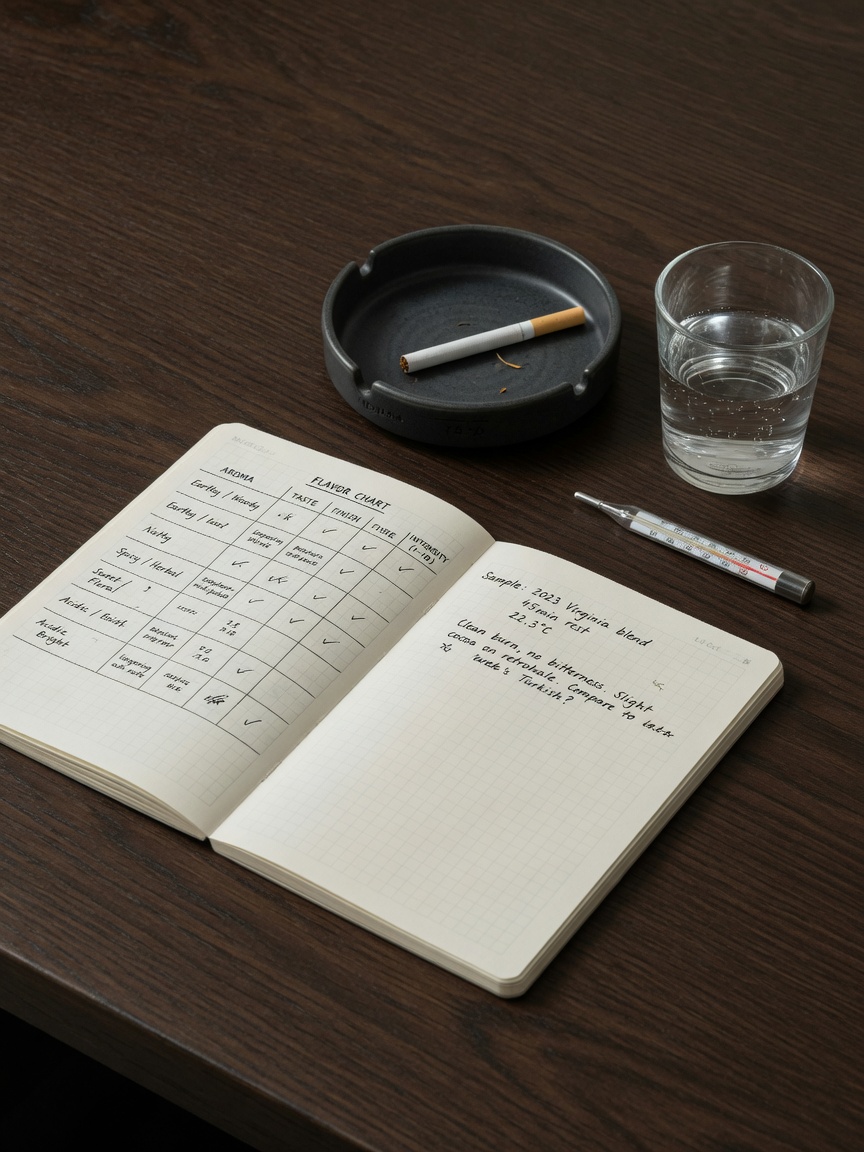
When industry and research talk about tobacco sensation, they separate aroma characteristics, smoke characteristics, and mouthfeel characteristics — even down to flavor type, aroma nuance, off-notes, irritation, and aftertaste. But in everyday consumer chat, it often shrinks to "smooth or harsh, strong or weak, expensive or cheap." What's missing in between is not talent — it's **training and a recording protocol**.
I've broken "they all taste the same" into six common sticking points — and I've personally fallen into every single one:
| Sticking point | What actually happens | What the result looks like |
|---|---|---|
| **Dimension collapse** | Strength, irritation, aroma, and sweetness all get kneaded into one "is it good to smoke" | Notes have only mood, no structure |
| **Only the first puff recorded** | The lighter gas and paper taste dominate the first 30–60 seconds | Every cigarette seems "a bit scorched / a bit harsh" |
| **No references** | No anchors in the head like "roasted almond / cedar / damp cardboard" | You can only write "smoke taste" |
| **Olfactory fatigue** | Resolution drops off a cliff after 4–6 cigarettes in a row | The whole second half is "seems a bit fragrant" |
| **Marketing words invading** | "Mellow, premium, natural aroma" occupies the keyboard | You can't line it up with your own notes from last month |
| **Words too broad** | "Tobacco taste" itself covers nearly every sample | Discrimination is zero |
In June 2022 in Hangzhou, two friends and I did a "blind comparison of three blended cigarettes." Before the evaluation, everyone swore they could tell them apart. When the first round ended, the three of us had written "normal smoke taste" 7 times, "a bit sweet" 4 times, and "throat irritation" 5 times. Our tongues weren't dead — we **had no mandatory fields**: nobody was required to write "retronasal main attribute," "irritation location (throat/nose/tongue)," or "aftertaste at 2 minutes." In the second round I forced a table format, and the differences appeared immediately — Sample B had clearer nuts in the middle, Sample C had more off-notes and dryness at the tail.
**Personal view:** "They all taste the same" is rarely your senses hitting zero; more often it's **a missing language protocol**. Once the protocol goes online, differences emerge from the fog; without it, even ten years of smoking still leaves you in the fog.
---
2. My Proposed "Tasting Language" Minimum Protocol
Don't chase poetry right away. Run the minimum protocol through about 20 times first, then talk about style.
2.1 The four mandatory fields
For each serious record, at least fill in:
- **Metadata**: date, place, temperature/humidity (if available), sample name/type, labeled tar and nicotine (copy them if on the pack), storage method (original pack/metal case/wet or too dry), your own state (stuffy nose or not, what you ate before the evaluation).
- **Timeline position**: cold scent / first 1–3 puffs / middle / tail / after leaving the mouth.
- **Attribute + intensity**: for example "caramel-sweet 3," "woody 2," "off-note (cardboard) 2."
- **Physical sensation location**: whether the irritation is in the nasal cavity, throat, or tongue root; whether dryness/astringency/burning is present.
Miss any one of these, and three months later even you can't reconstruct how it felt.
2.2 Intensity uniformly uses 0–5
| Score | Meaning | Self-check question |
|---|---|---|
| 0 | None | Completely can't write it |
| 1 | Faint | Only after being prompted do you think "seems there" |
| 2 | Clear but weak | You can point it out, but it doesn't lead |
| 3 | One of the clear main notes | If someone asks "what flavors are there," you mention it first |
| 4 | Prominent | Overpowers most other attributes |
| 5 | Dominant | Almost nothing else remains (rare, use with caution) |
**Personal rule:** in a single note, **at most two main notes at 3+ scores**; if you write four 4s in one breath, it's probably excitement, not discrimination — I did exactly that in Shanghai in 2021 after consecutive evaluations, and the next day, looking at the notes soberly, it was all inflation.
2.3 Attribute words first, metaphor words after
- **Attribute words (preferred)**: woody, nutty, caramel-sweet, grassy, earthy, leather, creamy, peppery, papery, scorched…
- **Metaphor words (optional, and must be recoverable)**: writing "like a freshly sharpened pencil" is fine, because it can be reduced to woody; writing "like a highway at dusk" is not, unless you immediately add "meaning cypress-like cool woody note, 2 points."
In industry and hobby communities, the cigarette/pipe flavor wheel commonly includes broad families such as spice, nut, plant/vegetal, earth, roast/savory, sweet, etc.; coffee and baijiu flavor wheel training follows the same logic: **first family, then intensity, then finer breakdown.** Tobacco consumer notes can borrow this entirely, without memorizing compound names first.
2.4 "When uncertain, downweight"
When burning is uneven, puffing too fast, nose is stuffy, or the environment is disturbed:
- automatically −1 on attribute intensity;
- or mark "doubtful";
- and never write doubtful items into a "conclusion sentence."
In one record in January 2024, I wrote the tail-end scorched note as "deep-roasted coffee 3." Watching the video back, the burn line had clearly wandered. After downweighting per the rule, I changed it to "scorched/bitter 2 (abnormal burn, doubtful)." **Honesty matters more than prettiness.**
---
3. A Description Framework: A Cigarette Broken into Seven Slots
The skeleton below is the table frame I've used almost constantly since 2024. You can copy it to your memo or a paper card.
Slot 1: Metadata (finish in 1 minute)
- Date/time / place
- Environment: temperature, humidity, any odor sources
- Sample: brand type, tar in mg, nicotine in mg (if any), approximate time of purchase/opening
- Storage: original pack, cigarette case, wooden box, refrigerator (refrigerator odor contamination is extremely common, must be written)
- Yourself: sleep, nasal cavity, food and mouth state in the 60 minutes before evaluation (coffee/hot and spicy/mint veto or downweight)
Slot 2: Cold scent (before lighting, 30–60 seconds)
From about **2–3 cm** away from the tobacco end, inhale naturally twice; don't press your nose onto it to "sniff dust." Ask:
- Main impression: caramel-sweet / green off-note / milky / wooden box / papery / almost no scent?
- Intensity 0–5
- Does it resemble a storage problem (damp, too dry, odor mixed)?
Cold scent is not "official flavor"; it is **expectation and an alarm**. Damp tobacco has a muted cold scent; too dry often carries sharpness and an empty-shell feeling.
Slot 3: Front notes (about the 1st–3rd puffs)
Lighter gas, paper taste, an instant sweetness, the first wave of irritation. **Personal view: the front notes fool you most.** Many "the first puff is really fragrant" experiences come from flavoring or the instant of lighting; the middle may not hold it up.
Slot 4: Middle (stable burn, the key zone)
Here, do **retronasal olfaction**: hold the smoke in the mouth briefly (commonly described in practice and textbooks as a hold of about **2–4 seconds**), then exhale slowly through the nose — instead of only recording a "kick in the lungs."
For the middle, write down mandatorily:
- Main aroma attributes 1–2, plus scores
- Harmony: round / scattered / fighting
- Off-notes: present or not; what they resemble (damp cardboard, green off-note, plastic feel…)
- Irritation: location plus score
Industry panelists typically look at aroma, harmony, off-notes, irritancy, aftertaste, and other dimensions; you don't have to score factory-style, but **dimension separation** must stay.
Slot 5: Mouth and body sensation (write separately from aroma)
| Item | What you answer | |
|---|---|---|
| Basic taste | Are sweet / bitter / sour obvious? On tongue tip or tongue root? | |
| Strength | Impact intensity 0–5 (don't mix it with "aroma is strong") | |
| Texture | Smooth / rough / powdery / coated | |
| Moisture feel | Moist / dry / getting drier as you smoke | |
| Astringency | Do both sides feel harsh | |
| Temperature feel | Does it burn or scald |
A pretty aroma with a dry, bitter tongue root is structurally "aroma score high, taste score low" — that is valid information, not "not knowing how to enjoy."
Slot 6: Tail
The burn enters the late stage: does it turn scorched, hot, hollow, off-notes rising, sweetness collapsing. Many samples can score 3 caramel-sweet in front and middle, and the tail is left with only dryness 3 + scorched 2. Judge only half a cigarette and you'll overestimate it.
Slot 7: Aftertaste (must watch the clock)
After the smoke leaves, record three points:
- **30 seconds**: mouth coating? What still hangs in the nasal cavity?
- **2 minutes**: returning sweetness or late bitterness? Does dryness get worse?
- **5 minutes** (optional): do you still want water to rinse your mouth?
**Personal view: aftertaste exposes state and process stability most.** In one comparison in Guangzhou in August 2023, sample A opened with a pleasing honey-like sweetness, but 2 minutes later a bitter film still sat on the tongue root and the nasal cavity still carried an off-note residue like damp cardboard — if I had only noted the first 3 puffs, I'd have given a high score; after writing the aftertaste, the score dropped by itself.
---
4. A Handy Word Bank: Record by "Family," Not by Stacking Adjectives
The bank below serves **cigarettes and blended-type daily recording**; cigar lovers' flavor wheels can be finer, but for beginners, running each family through until familiar beats memorizing 200 words.
Each family gives: a sense of definition, a reference, common locations, and easy confusions. Reference training needs no lighting — in November 2023, at my desk, I ran one round with raw almonds, cedar strips, light cream, black pepper, dried roses, and damp soil; far more efficient than puffing air and guessing.
1. Woody
- **What it's like:** pencil shavings, unvarnished cedar, dry oak; occasionally cypress-like coolness or damp wood dullness.
- **Reference:** cedar strips, pencil shavings, a clean raw-wood cutting board (avoid paint and essential oils).
- **Location:** common in cold scent and mid-to-tail; wooden-box storage amplifies "box wood."
- **Easy confusion:** box taste ≠ leaf taste; dry irritation ≠ high woodiness; moldy wood ≠ "premium aged wood."
- **Suggested way to write:** 「woody (cedar-leaning) 2, source doubtful: box/leaf?」
2. Nutty / Roasted
- **What it's like:** roasted almonds, walnut skins, cashews; sometimes leaning toward coffee beans, cocoa husks.
- **Reference:** lightly roasted almonds vs raw almonds; light-roast coffee beans (sniffing too long tires easily).
- **Location:** clearer with mid-section retronasal olfaction.
- **Easy confusion:** scorched-burnt written as nutty; rancid oil written as "rich nuttiness."
- **Rule:** when burn is abnormal, nutty descriptions get downweighted.
3. Burnt-sweet / Caramelized
- **What it's like:** caramelized sugar, lightly scorched malt, the sweet edge of roasted sweet-potato skin — not the straight sweetness of white sugar.
- **Reference:** cooled caramelized sugar, the scorched toast edge.
- **Location:** the pleasing zone of front and middle; at the tail it often collapses into burnt-bitter.
- **Easy confusion:** flavoring sweetness vs the leaf's own caramel-sweet; too-fast puffing's scorch pretending to be caramel-sweet.
4. Floral / Green
- **What it's like:** dried flowers, grass, hay, occasionally close to a tea note.
- **Reference:** dried roses, hay, fresh grass blades (mind allergies).
- **Location:** easier to catch in cold scent and front; often covered by roast-family notes in the middle.
- **Easy confusion:** minty coolness misread as floral; sharp green off-note misread as "premium herbal."
5. Earth / Leather / Aged-warehouse
- **What it's like:** potted-plant soil, a dry warehouse, old leather; more common in cigar contexts, weaker in cigarettes but "aged, musty, warehouse" still appears.
- **Reference:** slightly damp potted-plant soil, a clean old belt (without preservative stink).
- **Easy confusion:** damp-mold mustiness written as "aged aroma." **Musty and aged must be written separately.**
6. Creamy
- **What it's like:** light cream, warm milk skin; more about "round, moist, few edges" than a vanilla-ice-cream blast.
- **Reference:** a small spoon of room-temperature light cream.
- **Easy confusion:** low irritation directly equaling creamy; adding flavoring "milky" mixed with structural roundness.
7. Spice / Peppery
- **What it's like:** black pepper, clove, cinnamon edges (common in some blends and cigar descriptions).
- **Reference:** freshly crushed black pepper sniffed from afar.
- **Easy confusion:** throat irritation for pepper; nasal pungency for "spice layering."
8. Defects and off-notes (must be filed separately)
Writing "what smells bad" clearly is more valuable than forcing praise:
| Word | Roughly points to | Common trigger hints |
|---|---|---|
| Paper / cardboard | rolling paper, overdry, storage | cold scent and front |
| Green off-note | grass overdone, raw greenness | process/leaf quality/state |
| Scorch | burn too fast, line wandering | puffing rhythm, burn line |
| Plastic / chemical feel | material or environment odor transfer | storage, packaging |
| Ammonia irritation / pungent | irritation channel | separate from "aroma is strong" |
| Hollow / watery | thin aroma | overdry, leaf quality, over-light puffing |
**Personal view: defect words are half the territory of a tasting language.** A vocabulary that only praises never has enough discrimination.
9. Body-feel words (not aroma, but must be recorded)
Impact, throat sting, nasal sting, scalding, astringency, dryness, numb, lingering coating, water-craving intensity 0–5. Split "strong" into "impact 4 + throat sting 3 + aroma actually only 2," and you've begun being objective.
---
5. Building "Your Own" Word List: A 21-Day Executable Practice
Someone else's flavor wheel is a public map; **your tasting language** is the few roads you actually use on that map. My advice is "narrow first, then wide."
Week 1: only practice 6 attributes + intensity
Fixed and only: woody, nutty, caramel-sweet, green off-note/papery, dryness, irritation. No need to light a cigarette daily: use references to sniff for 5 minutes, score each reference 0–5, and write "which family it's closest to."
In October 2023, I forced myself not to use new words for a week. The result: mid-section resolution went up, random adjectives went down.
Week 2: add the timeline
The same 6 words must be filled into four slots: front / middle / back / aftertaste 2 minutes. Empty cells are allowed; "one flavor throughout" as a cheat for the whole thing is not allowed.
Week 3: add two personal anchor words
From feelings that genuinely recur for you, "promote" two words, such as 「cocoa husk」「maltose color」「warehouse dry earth」. **Promotion condition:** the same feeling appears in ≥3 independent records, and you can explain it to a friend with a reference.
Long-term rules (I still use them)
- **Keep the core list at 15–25 words.** Beyond that, merge synonyms.
- **New words have a 3-use trial:** put them in the "trial" slot; after 3 stable uses, really adopt them.
- **Each month, sample old notes:** randomly flip 3 entries and see whether you can recognize "the same structure" when buying blind samples. If you can't, you were doing literary writing at the time.
- **One serious tasting per session, only 1 cigarette;** for comparison, at most +1, with plain water and quiet breathing for 5 minutes in between. In 2021 in Shanghai I evaluated 6 in a row, and the notes filled with "seems a bit fragrant" — pure fatigue product.
---
6. One Complete Working Process (Including Problems and Corrections)
Below is my actual pace on the evening of April 12, 2024, in the rented room, so you can adapt it into your own version.
**Environment:** 24.1℃, RH about 48%, window open a finger-width crack, no aromatherapy. **Myself:** no coffee in the 40 minutes before the evaluation, no mint toothpaste (the lesson from the 2022 Hangzhou friends session: a mint candy turned all three people's notes into "fresh"). **Tools:** plain water, a timer, a paper form.
Steps
- **Write metadata** (1 minute) — a note without storage conditions can't explain "where the wood scent came from" three months later.
- **Cold sniff** 2 times, record main attribute + score.
- **The first 3 puffs after lighting** record only lighter gas, paper taste, and the first irritation; no final conclusion.
- **Middle, puffs 4–8:** every 2 puffs, do one retronasal olfaction; hold in the mouth about 2–4 seconds, exhale slowly through the nose. Write 1–2 main aromas, off-notes, irritation location.
- **Tail:** record at least 2 more puffs: scorched? hollow? hot?
- **After extinguishing/ending**, watch the clock: write one line at 30 seconds and one at 2 minutes.
- **Conclusion sentence template (mandatory):**
`Through the middle, A (score) + B (score) dominate; irritation is at X, intensity n; aftertaste 2 min: …; one-line risk: description ≠ safety.`
Real problems I met
- **Problem 1: wanting to write too many words.** The first draft of the middle had 7 attributes, all scoring 2–3, which equals no priorities. Correction: main notes ≤2.
- **Problem 2: taking dryness for woodiness.** After comparing cedar strips, I found dryness is a body sensation and woodiness is an aroma family — they must be written on separate lines.
- **Problem 3: not bothering to wait for the aftertaste.** Twice I closed the notebook at 30 seconds, and the next day I completely couldn't remember whether the late bitterness appeared. Correction: a phone alarm at 2 minutes; write only when it rings.
What a "qualified note" looks like (structure example, not brand endorsement)
2024-04-12 21:40 rented room 24℃/48%RH | blended, tar about 10 mg | original pack, stored dry | state OK
Cold scent: caramel-sweet 2, slight paper note 1
Front: lighter gas 2, throat sting 2
Middle retronasal: nutty 3, caramel-sweet 2, woody 1; off-notes 0–1; impact 3, tongue root dry 2
Tail: burnt-bitter 2, dryness 3, sweetness collapsing
Aftertaste 30s: thin bitterness at tongue root; 2min: still dry, want water 3
Conclusion: middle structure is clear, tail and aftertaste drag it down; descriptive ability↑ ≠ risk↓
Two years later this kind of note still works. Compare it with the opening three "tastes okay" notes — the information content is not in the same order of magnitude.
---
7. When Talking with Others: How to Avoid Talking Past Each Other
- **Align rulers first:** explain what your 0–5 means; if the other side uses "percent-based comfort," translate first, then argue.
- **Align sample state first:** damp, overdry, different batches — arguing is pointless.
- **Forbid throwing literary sentences only:** "an elegant aristocratic aura" please change to attribute + score.
- **Accept individual differences:** someone insensitive to floral aromas isn't deceiving you; let them contribute with their strong dimensions (e.g., irritation location, aftertaste dryness).
- **Double-blind is useful but don't mythologize it:** among friends, wrapping cigarettes in paper with numbers already removes half the brand filter.
In public materials and cigar/pipe communities, the flavor wheel is emphasized again and again for a simple reason: **it connects private sensation to public vocabulary.** Your personal language is "a common subset + intensity habits + timeline habits" on the public wheel — not a whole new Martian language.
---
8. If You're Quitting: What a Tasting Language Can and Cannot Do
Can:
- Identify which part of the "ritual" is truly missed (e.g., just the mid-section caramel-sweet 3, not the whole cigarette).
- Turn vague craving into a discussable trigger, making it easier to swap in replacement behaviors (walking, gum, nasal rinse, etc. — per your own quitting plan).
- See that many "good-smoking memories" are situational memories (drinking sessions, desk stress), not the leaf itself being irreplaceable.
Cannot:
- Turn "I can taste now" into a reason to keep using.
- Use refined description to offset the health ledger.
**Personal view:** for someone who wants to quit, the biggest value of a tasting framework is **demystification** — when the altar of "they all taste the same" becomes a running ledger of "mid caramel-sweet 3, aftertaste dry 3," the magic of the cigarette as an emotional symbol drops a notch. Lowering the magic helps quitting; elevating ritual does the opposite. You pick your own purpose.
---
9. A Recording Template You Can Copy Directly
[METADATA]
Date:            Place:            Temp/humidity:
Sample:          Tar/nicotine label:
Storage:         Your own state:
Food/mouth 60 min before:

[COLD SCENT] main attribute____ score__ | note:
[FRONT 1–3 puffs] lighter/paper__ | irritation location____ score__
[MIDDLE] aroma A____ score__ | aroma B____ score__
         off-notes____ score__ (like: ____)
         harmony: round / scattered / fighting
         impact__ | dryness__ | astringency__ | location:
[TAIL] change:
[AFTERTASTE] 30s:
         2min:
         5min (optional):
[CONCLUSION] middle dominated by____; irritation at____; aftertaste____.
[DOWNWEIGHT/DOUBT] □abnormal burn □stuffy nose □environment disturbance □too-fast puffing
[VETO STATEMENT] description ≠ safer; purpose of this session: record / compare / quit-trigger analysis
Intensity convention: 0 none · 1 faint · 2 clear but weak · 3 one of the main notes · 4 prominent · 5 dominant (use with caution)
---
10. Five Personal Rules I Hope You Take Away
- **Forbid "smoke taste / pretty fragrant / average" as a conclusion** — at least attribute + score + position in time.
- **Mid-section + retronasal olfaction + 2-minute aftertaste** — remove any one of these, and your "objectivity" falls back to chat.
- **Intensity and location first, adjectives later**; metaphors must be reducible to a reference.
- **Core list 15–25 words, expand only after filling them up**; new words get a 3-use trial.
- **One cigarette per session, stop when the state is wrong** — the flowery words on a tired day are all fake data.
Back to the night of October 7, 2023: I did not suddenly become a more sensitive nose. I just finally agreed to use a clumsy table and turned my tongue and nose from "emotion switches" into "sensors." A sensor doesn't guarantee you'll be happier, but it guarantees you'll speak clearly. Once you can speak clearly, you earn the right to judge — whether you want to keep comparing structures, or see through the structures and walk away.
Language is a tool. The first line of a tool's manual should be: it measures the structure of sensation, not issues a pass for smoke.
Old-style notes
Mood words: tastes okay, a bit harsh, hard to say
Tasting record
Structured: attribute + 0–5 score + position in time