Overview
The Complete Analysis of the Special Fermentation and Aging of Cigar Tobacco Leaves
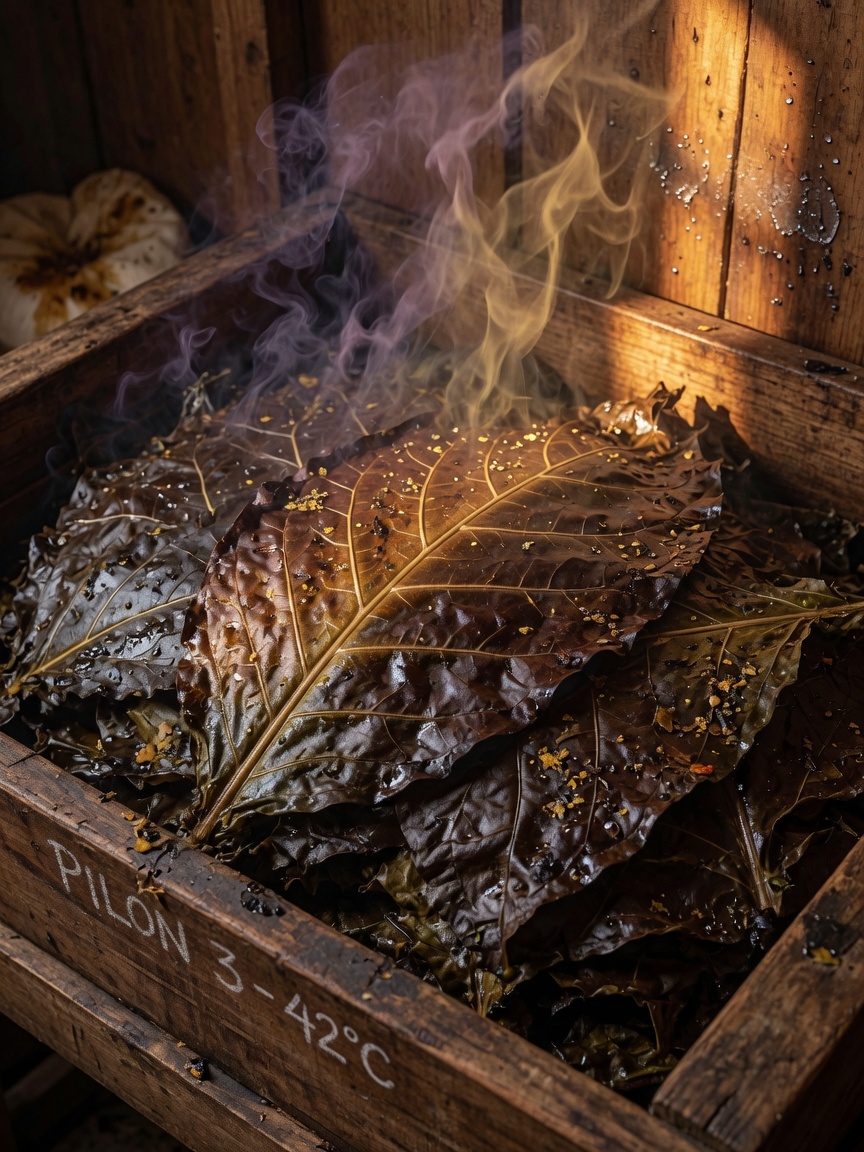
The same batch of cigar tobacco leaves, right after curing (commonly air-curing or shade-drying), often still carries raw, harsh, green and uncoordinated notes. But after pile fermentation (Pilón / bulk fermentation), warehouse aging, and then being rolled into whole cigars and rested for a period, the same raw material can present cleaner combustion, a smoother mouthfeel, and recognizable layers of cocoa, wood, nuts, honeyed sweetness, spice, and earth.
This is not the mysticism of "it just gets better by sitting around," but a process system that relies heavily on moisture, temperature, microorganisms, enzymes, and time. Cigars differ greatly from modern flue-cured cigarettes in post-processing logic: flue-cured tobacco relies more on kiln setting and formula blending; premium cigar tobacco, by contrast, "writes" a large share of its quality into fermentation and aging.
This article proceeds along the line "position in the industry chain → Pilón principles → different leaf positions and fermentation forms → chemical changes → leaf aging → post-roll aging → influencing factors → misconceptions," systematically analyzing the entire process from pile fermentation to post-roll aging. A note upfront: what the process optimizes is usability, combustibility, and sensory coordination — not turning cigars into "health or wellness" products.
01. First, get the position right: where fermentation and aging sit in the cigar chain
A simplified lifecycle of cigar tobacco leaf can be written as:
Field growth and harvest
    ↓
Curing (air-curing/shade-drying, etc., fixing the basic color and initial chemical profile)
    ↓
Pre-treatment (cleaning/pest control, sorting, rehydration, moisture balancing)
    ↓
Pile fermentation Pilón (and, when necessary, secondary fermentation, case fermentation, etc.)
    ↓
Breaking down piles, re-sorting, grading, baling
    ↓
Leaf warehouse aging / maturation (measured in months; premium material can go longer)
    ↓
Blend design + rolling (filler / binder / wrapper)
    ↓
Post-roll aging (moisture rebalancing and aroma integration)
    ↓
Shipping, sales, smoking
Let us first clarify a few concepts that are easily confused:
| Concept | Common meaning | Time scale (order of magnitude) | Intensity |
|---|---|---|---|
| Curing | Initial processing after harvest, removing most free water, forming the basic color and structure | Days to weeks | High (decides "whether it can enter post-processing") |
| Fermentation | Actively controlled moisture, piling or boxing, accelerating biological–chemical transformation | Days to weeks (can be multiple rounds) | Medium-high (pile temperature can rise noticeably) |
| Leaf aging | Baling and warehousing after fermentation, slow harmonization | From months, can be years | Relatively low ("slow simmering") |
| Post-roll aging | Resting the finished rolled cigar | Weeks to years, varies | Low (rebalancing and integration) |
This is how to remember it:
Curing decides the "skeleton of the raw material"; fermentation decides "whether it can go from raw to usable"; aging decides "whether it can go from usable to coordinated and layered."
02. Why cigar tobacco leaf is especially dependent on "special fermentation"
1. Differences in curing methods mean different post-processing tasks
Cigar tobacco predominantly uses relatively gentle curing paths such as air-curing and shade-drying, preserving more substrates that later microorganisms and enzymes can "reprocess" (proteins, polysaccharides, polyphenols, pigment precursors, etc.). Flue-cured cigarette leaf, by contrast, has already undergone extensive sugar transformation, color change, and setting during intensive kiln drying, and the industrial side emphasizes blending, flavoring/casing, and cut-rag processing.
Therefore, if cigar tobacco leaf skips adequate fermentation, the typical results are:
- Pronounced raw green notes, ammonia harshness, and a green, unripe feel;
- Uneven combustion, unsatisfactory ash whiteness, and burn-holding ability;
- Aroma that is "scattered, sharp, and short," lacking fullness and depth;
- Insufficient wrapper elasticity and color uniformity, with higher losses during rolling.
2. The real industrial goals of fermentation
In professional contexts, cigar fermentation is not about "making an alcoholic gimmick," but serves multiple engineering goals at the same time:
- Reduce off-notes and harshness to improve smokability;
- Promote macromolecule degradation, releasing and transforming aroma precursors;
- Adjust color and flexibility to serve wrapper appearance and processing performance;
- Improve combustion-related chemical balance (in synergy with minerals, organic acids, nitrogenous compounds — not a single indicator);
- Improve batch consistency, making subsequent blending more controllable.
03. Pile fermentation (Pilón) principles: how a pile of tobacco leaves "heats itself and changes itself"
1. What is Pilón
Pilón (also often written "pilon"; in Chinese terminology, pile or stack fermentation) is the most classic and fundamental fermentation form for cigar tobacco leaves: rehydrated leaves with suitable moisture content are stacked into a pile/heap with volume and heat-retention capacity, making use of:
- residual respiration and oxidation of the leaves themselves;
- microbial metabolic heat on the leaf surface and in the environment;
- central temperature rise caused by the heat-retaining pile;
to drive enzymatic and non-enzymatic chemical reactions, completing the transformation "from raw leaf to processable leaf" within days to weeks.
It is not as simple as throwing leaves into a fermentation tank — it is a complete process chain including pre-treatment, stacking, temperature measurement, turning, breaking down the pile, and re-sorting.
2. The "invisible half" before fermentation: rehydration and moisture balancing
The success or failure of pile fermentation is often largely decided before the pile is built. In published processes and research, common preparatory actions include:
- Cleaning and necessary pest control / sanitation (to prevent storage pests and cross-contamination);
- Preliminary sorting: removing severely moldy, damaged, or unsuitable leaves;
- Rehydration: raising the moisture of overly dry leaves into a range where they are pliable and biochemically reactive (target moisture differs by intended use; literature and factory parameters usually give per-use ranges, not a single magic number);
- Moisture balancing: in a conditioning room or under resting conditions, making moisture more even inside and outside the leaf and from leaf to leaf, avoiding "wet outside, dry inside," which causes partial overheating or partial non-fermentation.
Moisture too low: pile temperature fails to rise, transformation is slow, and green, raw notes easily remain.<br>Moisture too high: risk of anaerobiosis and mold rises; the probability of uncontrolled rancidity, musty off-flavors, and ammonia harshness increases.
3. How the pile works: the insulated reactor model
A qualified Pilón can be understood as a low-tech, high-experience bioreactor:
| Element | Function |
|---|---|
| Pile volume and shape | Decide heat retention and the oxygen penetration gradient; too small and it is hard to heat up, too large and it is hard to shed heat or turn thoroughly |
| Stacking layers and tightness | Affect heat transfer, mass transfer, and local oxygen partial pressure |
| Cover and environment | Reduce excessive surface moisture loss and maintain the microclimate inside the pile |
| Leaf position and maturity | Decide the initial sugar, nitrogen, phenolic, pigment, and microbially available substrates |
| Temperature measurement points (especially the core) | Determine whether the pile is heating up, holding temperature, or dangerously overheating |
The pile is not isothermal: there is usually a hot center, cool edge gradient, and a trend of oxygen decreasing from outside to inside. This is the physical reason turning (re-piling) is mandatory — leaves at the center must move to the outer layers and outer leaves to the inner layers, to avoid part "burning past the point" and part "still raw."
4. Temperature profile: heat-up — hold — cool-down, not "the higher the better"
One of the core monitored indicators of cigar pile fermentation is core temperature. The typical process logic is:
- Heat-up phase after building: microbes and respiration are active; temperature climbs from ambient level;
- Hold-and-transform phase: keeping within the process-allowed working range, driving degradation of proteins, starch, pectin, etc., and transformation of aroma precursors;
- Threshold turning / dismantling: when temperature approaches or touches the safety ceiling, or the holding time target is reached, the pile must be turned to shed heat and rebuilt;
- Multiple cycles: premium material often undergoes more than one round of pile fermentation, with intensity adjusted to leaf type, use, and target style.
Temperature too low: insufficient transformation, residual off-notes.<br>Temperature out of control on the high side: possible "burning of the pile" — excessive destruction of aroma precursors, abnormal color, reduced usability, and in serious cases the material is scrapped.<br>Therefore, the essence of Pilón is walking a tightrope between effective transformation and thermal damage, accomplished through experience, temperature measurement, and turning discipline.
5. Turning, breaking down, and sorting: the "quality control valve" of fermentation
A complete pile fermentation typically includes these control actions:
- Time- or temperature-triggered turning: interrupts local overheating and evens out moisture and oxygen;
- Observing color, odor, and feel: checking for abnormal rancidity, mold spots, or ammonia harshness surges;
- Spreading out to cool and re-balancing after dismantling;
- Re-sorting and grading: fermentation amplifies differences between leaves; substandard leaves must be removed;
- Entering secondary fermentation or switching to milder methods such as case fermentation when necessary (especially for delicate wrapper).
Research and industry reviews universally emphasize: cigar leaf pile fermentation is not an isolated step but a chain of "rehydration — piling — fermentation — turning — dismantling — sorting — moisture control — baling"; instability in any link later becomes off-notes, poor combustion, or batch drift in the finished cigar.
04. Wrapper, binder, filler: not all leaves use the same "heat treatment"
1. Division of labor by use
| Position | Main function | Fermentation focus (summary) |
|---|---|---|
| Filler | Provides the main smoke volume, strength, and primary aroma | Transformation must be thorough; off-notes and harshness must be suppressed; can withstand relatively stronger pile fermentation |
| Binder | Holds the filler shape and assists combustion | Toughness, combustion, and a certain aroma contribution; intensity between filler and wrapper |
| Wrapper | Appearance, touch, first impression of aroma, and beauty of burning | Color uniformity, oil content and elasticity, damage rate; the process tends to be more refined and must avoid scorching and color differences |
Wrapper usually receives more cautious moisture management and may use case fermentation (packing/case fermentation) and other methods easier to control for temperature and humidity, reducing damage to thin, high-value leaves from overheating of the pile core.
2. Other fermentation forms (brief)
Beyond pile fermentation, common forms in industry and research include:
- Case/box fermentation: leaves are packed into boxes or cabinets, convenient for moisture control and transport; mostly used for wrapper and binder;
- Barrel fermentation: some processes borrow oak barrels and other containers, emphasizing micro-environments and possible trace constituent interactions (more common in specific style explorations; not standard in all regions);
- Medium fermentation: under controlled conditions, specific media are introduced (such as plant decoctions and sticky rice water in certain traditional processes) to modulate the fermentation progression and flavor direction — this is a process choice, not "the more you add the more premium," and it certainly does not mean healthier.
The basis for selection is usually: variety and origin, post-curing state, target use (wrapper/binder/filler), factory temperature-humidity conditions, and quality-risk preference.
05. What happens inside the leaf during fermentation: three engines
1. Microorganisms
Bacteria, yeasts, and similar organisms on the leaf surface and in the pile's micro-environment (dominant groups vary with origin, season, and sanitary conditions) will:
- secrete amylase, protease, pectinase, etc., dismantling macromolecules;
- metabolize sugars and amino acids, producing organic acids, alcohols, carbonyl compounds, etc.;
- change local pH and redox state, in turn modulating enzyme activity and non-enzymatic reactions.
Appropriate microbial activity is the key to the pile "heating up spontaneously" and accelerating transformation; when out of control, it turns into mold, rancidity, and abnormal harshness.
2. Enzymes (endogenous + microbial)
| Direction | Approximate result (qualitative) |
|---|---|
| Starch → soluble sugars | First provides materials for later reactions, then is consumed or enters the Maillard reaction |
| Protein → peptides/amino acids | Reduces part of the harshness sources and provides the nitrogen end for Maillard |
| Degradation of pectin and other cell wall substances | Improves smoothness and processing performance |
| Polyphenol oxidation | Darkens color, reconstructs the phenolic profile |
| Lipid-related transformations | Affect green/fatty aroma fragments; excessive amounts appear as green off-notes |
3. Non-enzymatic chemistry
Continues steadily under moderate moisture and pile temperature:
- Maillard reaction: reducing sugars + amino acids → pyrazines, pyrroles, furans, etc., contributing roasted, nutty, cocoa-like directions;
- Carotenoid degradation: forming damascenone, ionone, megastigmatrienone and other neutral aroma-related compounds;
- Degradation of cembranoids and other terpenoids: related to tobacco's characteristic aroma;
- Polyphenol and pigment changes: appearance moves from "raw" to "ripe."
Public research progress also points to an important phenomenon: aroma substances do not simply increase the longer fermentation goes on. In some pile/artificial fermentation observations, characteristic aroma component contents can show a rise-then-fall pattern, with a process inflection point; over-fermentation may keep destroying or volatilizing "good things already generated."<br>Therefore, master-level fermentation judgment is essentially stopping at the favorable range of the curve, not "piling until it can pile no more."
4. Common directions of compositional change (trends only)
| Component category | Common trend in fermentation | Sensory meaning (summary) |
|---|---|---|
| Starch / part of polysaccharides | Decrease | Off-notes and raw feel decrease |
| Reducing sugars | Often fluctuate first, then consumed | Participate in Maillard and also affect the finish |
| Protein | Tends to decrease | One source of harshness is weakened |
| Nicotine and other alkaloids | May decrease somewhat or transform | Strength and harshness are reconfigured (not equal to "harmlessness") |
| Organic acids and pH | Profile rearrangement | Affect smoothness and sharpness |
| Polyphenols | Total amount and forms change | Color, astringency, smoke texture |
| Volatile aroma substances | Generated — accumulated — possibly declining | Key to layering and cleanliness |
Always remember: absolute values differ enormously by variety, position, origin, initial moisture, and process intensity; there is no universal "standard test table" for all cigars.
06. Leaf warehouse aging: after fermentation, why "wait" again
Fermentation pushes the leaf from "clearly raw" to "basically usable," but high-quality material often still enters baled warehouse aging (aging / maturation).
1. The division between aging and fermentation
- Fermentation: short cycle, higher intervention, "cutting the knot at one stroke" through pile temperature and microorganisms;
- Aging: long cycle, lower intensity, letting oxidation, esterification, slow Maillard, and moisture equilibration continue under relatively gentle temperature and humidity.
Common goals of the aging stage include:
- further suppressing residual harshness and uncoordinated sensations;
- shifting aroma from "sharp and scattered" toward "concentrated and moist";
- stabilizing color and moisture for easier blending and rolling;
- making different batches more predictable on the time dimension.
In public science communication and industry accounts, leaf warehouse aging measured from months as a starting point is common, and some premium-grade materials go significantly longer. The specific duration depends on leaf type, fermentation completion, warehouse climate, and brand style; there is no universal formula that "after N years it must be at its peak."
2. Key controls in warehousing
- Temperature: too high accelerates degradation and pest/mold risk; too low nearly stops transformation;
- Relative humidity: maintaining the balance band where leaves neither crack dry nor reabsorb moisture and mold;
- Ventilation and stacking: preventing localized damp stuffiness;
- Light protection and sanitation: reducing oil oxidation off-odors and pests;
- Periodic inspection: mold spots, off-odors, moisture drift, package damage.
Aging is not throwing bales into a warehouse and forgetting them; it is slow-paced quality control.
07. Post-roll aging: how three leaves become "one cigar" again
At the moment rolling is complete, a cigar's interior is still "a system that was just forcibly combined":
- The moisture content of filler, binder, and wrapper may not be fully consistent;
- The volatile substances carried by each part have not yet fully interpenetrated;
- The structural stress and local density differences caused by rolling pressure need time to relax;
- The surface state of the freshly rolled wrapper and the combustion interface are still stabilizing.
1. What post-roll aging mainly does
- Moisture rebalancing: the moisture curve of the whole cigar from outside to inside stabilizes, and combustion becomes more even when smoking;
- Aroma integration: the body of the filler, the aroma of the wrapper, and the connective feel of the binder gradually "grow together";
- Reduced sharpness: certain raw green notes and harshness are rounded off in slow oxidation and esterification;
- Style setting: under the brand's set temperature and humidity, moving toward the target profile (sweeter, spicier, woodier, more mellow, etc.).
2. The time curve: not infinitely better
Experience allows roughly dividing post-roll aging into several cognitive stages (exact weeks/months vary with size, wrapper thickness, initial moisture, and environment):
| Stage | Approximate characteristics |
|---|---|
| Newly rolled period | May be tight and sharp, with separated components and occasional unstable combustion |
| Integration period | Moisture stabilizes; aroma begins to taste "like one cigar" instead of "three layers of leaf" |
| Optimal window | Clear layers, controlled harshness, cleaner finish (varies by product) |
| Over-aged risk zone | Aroma may fade and flatten; oiliness and vitality drop; some delicate high notes are lost first |
Like leaf fermentation, post-roll aging also has diminishing returns and even decline. Expensive and long-aged narratives must rest on qualified storage conditions and a leaf quality that can withstand time; "the longer, the more magical" is marketing talk, not a law of physics.
3. Common-sense principles for post-roll storage environment
Professional humidified environments emphasize stability, not frequent large swings:
- Stable temperature, avoiding heat accelerating off-flavors and dry cracking;
- Stable humidity, avoiding burst wrappers, mold, or burning too fast/too slow;
- Moderate air exchange, avoiding closed-space off-odor accumulation;
- Storing products of different strengths and origins in separate zones to reduce cross-flavoring.
If the conditions of a home collection fluctuate sharply, so-called "aging" can turn into "torment."
08. A master table: the key variables that truly decide the final flavor
| Variable | Mechanism of influence |
|---|---|
| Variety and region | Decide the substrate profile (sugar–nitrogen ratio, polyphenols, pigments, minerals) |
| Field maturity and leaf position | Decide initial harshness, oil content, and aroma potential |
| Curing quality | Decides whether the fermentation starting point is clean |
| Rehydration and balancing | Decide whether reactions in the pile start evenly |
| Pilón temperature–time–turning | Decide the depth of transformation and whether scorching occurs |
| Fermentation rounds and form | Differences among pile/box/medium paths |
| Leaf aging duration and warehousing | Decide the distance from "usable" to "coordinated" |
| Blend structure | The logic of combining leaves from multiple regions and positions |
| Rolling tightness and structure | Affects combustion and the smoke path |
| Post-roll aging | Decides the degree of integration and the evaluation window |
So the "this one is mellow, that one is sharp" you perceive in tasting is often the integral result of the whole chain, not some mysterious label.
09. Correcting common misconceptions
Misconception 1: "Fermentation/aging removes all harmful substances"
Fermentation and aging change the form and content trend of nicotine, reduce some irritating components, and reconstruct the aroma profile, but they are absolutely not harm-removing processing. A cigar is still a tobacco product; combustion or high-temperature pyrolysis still produces a complex mixture, and health risks cannot be written off with "all-natural fermentation."
Misconception 2: "The longer the aging, the better for sure, and certainly healthier"
Time is only one variable. Poor leaf quality, over-fermentation, and uncontrolled storage humidity only magnify defects over time. On the health dimension, vintage is not a harm-reduction certificate.
Misconception 3: "Stacking leaves at home and adding wine, honey, and microbes can replicate premium cigars and is safer"
Industrial Pilón depends on batch consistency, temperature-measurement discipline, sanitation systems, and sorting standards. Home-workshop pile fermentation easily breeds mold and harmful microorganisms; adding sugar, alcohol, and flavorants may create "surface aroma," which is not the same as the chemical path of regulated processes, and cannot be inferred to mean lower exposure risk.
Misconception 4: "Only one country's process counts as real fermentation; all others are fake"
Cuba, the Dominican Republic, Nicaragua, Honduras, and emerging regions including China have all developed fermentation–aging systems adapted to their local leaf types. The differences lie in parameters, intensity, style goals, and quality-control capability, not in a "mysterious, unreplicable" magical nationality.
Misconception 5: "Smells fragrant = harshness is already low = can puff large and often"
Aroma quality and exposure to nicotine and combustion products are different dimensions. A milder, smoother smoke may reduce "discomfort" and instead make people overlook intake — behaviorally this deserves caution, not treatment as a safety signal.
10. Conclusion: read flavor through process, look at risk with reason
The special feature of cigar tobacco leaf is that it entrusts a large share of quality formation to the long biochemical–engineering work after curing:
- Pilón pile fermentation uses moisture and pile temperature to drive microorganisms and enzymes, pushing raw leaf toward usable leaf;
- Multi-round control and sorting decide whether transformation is even and whether it passes the aroma inflection point;
- Leaf warehouse aging uses time as a slow polish;
- Post-roll aging lets wrapper, binder, and filler grow back into a complete flavor structure in one cigar.
Reading this chain helps to understand:
- why factories in the same region can differ greatly in style;
- why thin wrapper leaves are more expensive and suffer higher losses;
- why some products emphasize long aging while others emphasize fresh vitality;
- why the price contains not just the "brand" but also failure rates and time costs.
But the boundary must still be stated clearly:
Fermentation and aging explain "why this cigar tastes the way it does when smoked," not "why it is friendly to health."<br>The process changes chemical balance and sensory experience; the health attributes are still decided by tobacco exposure itself.
If your reading context is tobacco cognition or quitting-smoking groundwork, treat this article as a tool for dismantling the halo: once "handmade, natural fermentation, aged for years" no longer automatically equals "premium and harmless," choices become more sober — whether it is staying away from tobacco or understanding product differences within legal, compliant limits.
This article is for process and science communication purposes only; it does not constitute any medical advice, does not encourage smoking, and does not guide minors to touch tobacco products.
Fermentation
Short cycle, higher intervention; the transformation is completed rapidly through pile temperature and microorganisms
Aging
Long cycle, lower intensity; oxidation and esterification continue steadily under gentle temperature and humidity